Skip to content
Trace Margin

Independent AI voice-agent research

For the people accountable for the call.

Voice agents. Real decisions.

The call
sounded good.
Did the
booking stick?

Research the outcome, not just the voice.

Independent research and practical tools for US operations, finance and procurement teams buying AI voice agents.

Free tools. No sign-up. Your inputs stay in your browser.

Forest-green telephone receiver and coiled cable on an ivory deskTHE OUTCOME MATTERS.
From the sample call00:52.7
00:40.4 Booking requested00:42.1 Record confirmed
AI-generated editorial image · Waveform from a synthetic call, not a supplier benchmark.

Read the evidence.
Make your own call.

research studies
12
buyer tools
10
provider profiles
15
Independent by design.
No paid placement. No referral fees. ↗

01 / The listening room

Listen past
the voice.

A convincing conversation is only one part of the job. Follow a call through to the booking record—or the person who receives the handoff.

Two synthetic cases. No supplier scores. Select a transcript line to inspect what actually changed.

Illustrative call — not a supplier benchmark

Inbound plumbing booking · water heater leak

+1 (312) 555-0187 · Inbound · plumbing dispatch · Phoenix service area (synthetic)

Duration
00:52.7
Usage (assumed)
$0.16
Outcome
Booked · record written
Caller
Agent

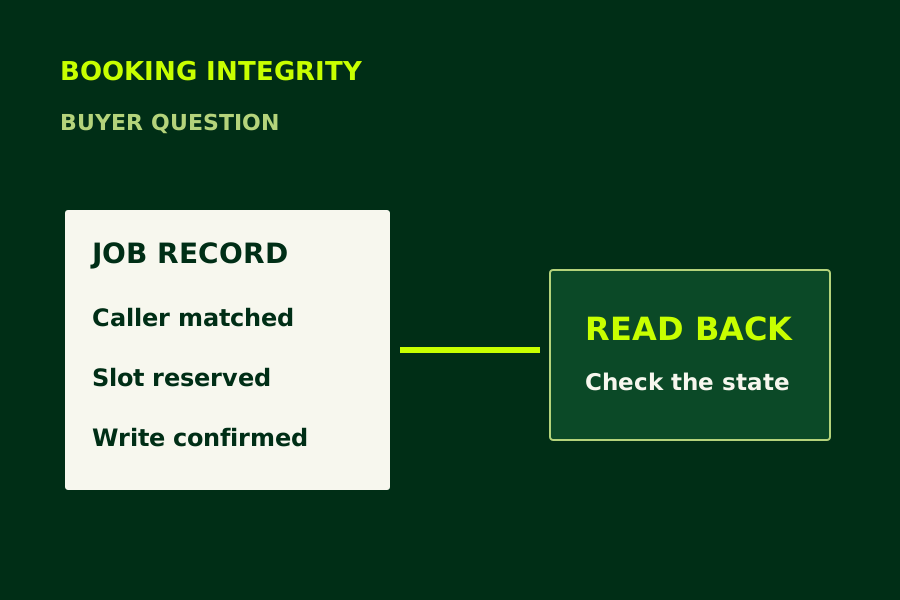
Watch for the difference between a booking request and a confirmed system write. Illustrative cases; not executed against any supplier.

Build your own trial pack

02Find your starting point

One queue. A clear boundary.

Start with the workload, not a vendor logo. Each queue is bounded: written exclusions, a destination system and a named fallback.

Eligible for the agent

  • New service requests inside the service area
  • Arrival-window selection from live availability
  • Confirmation text after the job record exists

Excluded — route to a person

  • Gas smells, flooding or electrical hazards
  • Invoice disputes and warranty claims
  • Quotes for work not on the price book

Integration destination

Field-service job system (write access to jobs and arrival windows)

Fallback coverage

Dispatch supervisor, staffed 07:00–18:00; on-call technician phone after hours

Baseline data you need before a pilot

  • Missed and abandoned calls by hour
  • Booked jobs per answered call
  • Repeat calls for the same job within 48 hours
Illustration of a dispatch desk with a wired phone and a job board
Readiness preview

Does a named person receive every handoff while the agent runs?

Read the full queue profile

03The cost of completion

The price of a minute. The cost of an outcome.

A per-minute quote leaves out setup, failed attempts and human intervention. Compare the full cost of completing the task, then change the assumptions to see what matters.

Cost per completed, policy-compliant task Example data
  • Direct AI usage only

    The figure a per-minute price suggests

    $1.24
  • AI agent, all-in

    Every attempt, rescue, fee and setup

    $4.37
  • Answering service

    Messages still need callbacks

    $3.47
  • Staff only

    Staffed hours, loaded cost

    $5.30

Synthetic Phoenix plumbing example. Planning assumptions, not market benchmarks.

Change the assumptions

Synthetic example. Change these inputs to explore your own scenario.

Assumed

Assumed

Assumed

Assumed

Assumed

Assumed

Updates when you leave a field. Other costs use the synthetic Phoenix plumbing defaults.

04The research desk

Better questions. Better buying decisions.

View all research
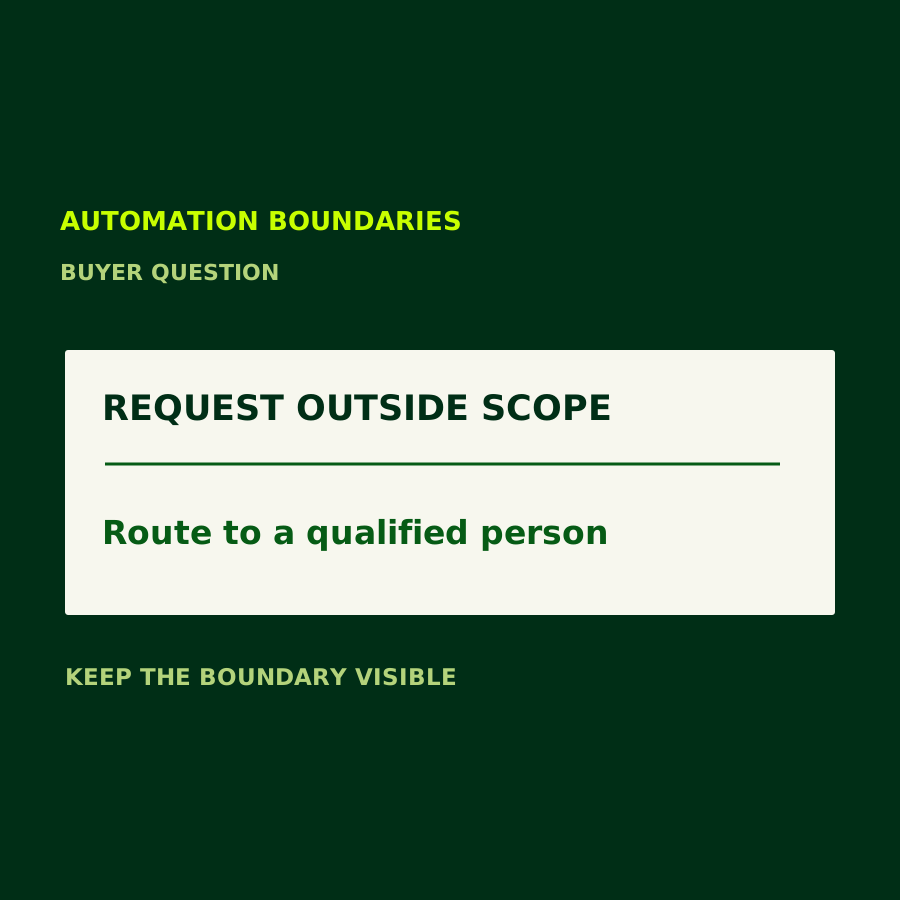
  1. Some requests need a person. Identify request → Check exclusions → Stay in scope → Route to a person.

    Compliance

    What calls should not be handled by AI?

    16 July 2026 / 5 min

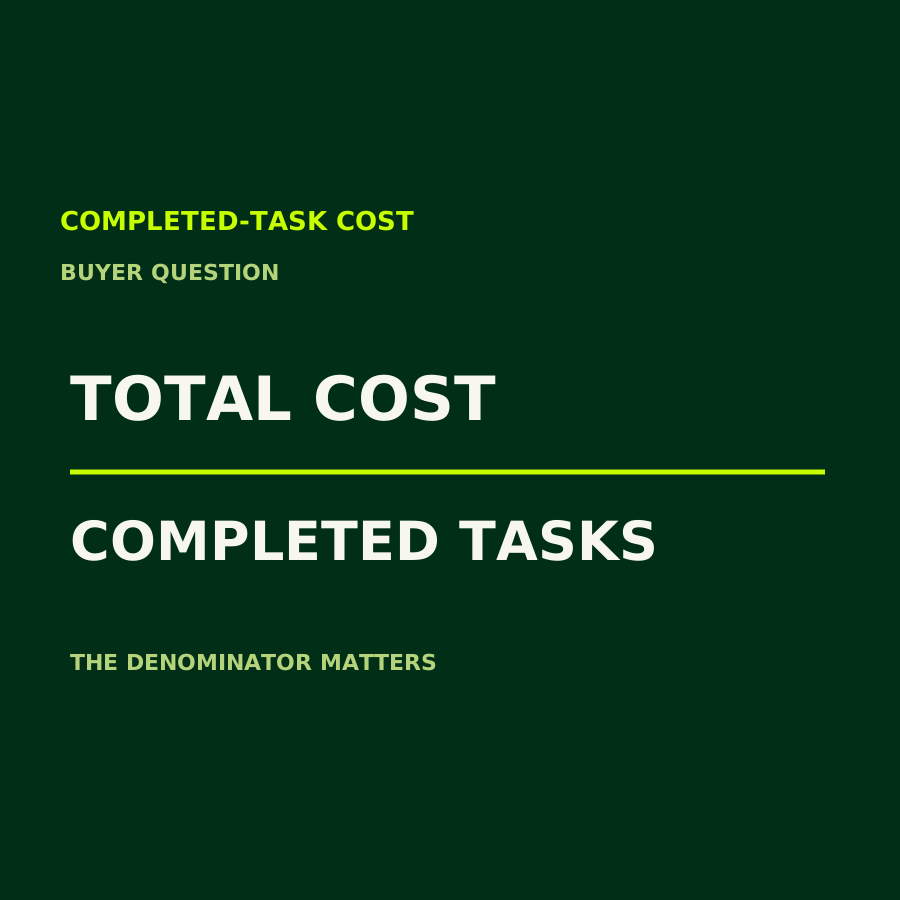
  2. Count verified work in the denominator. All attempts → All costs → Verified tasks → Cost per task.
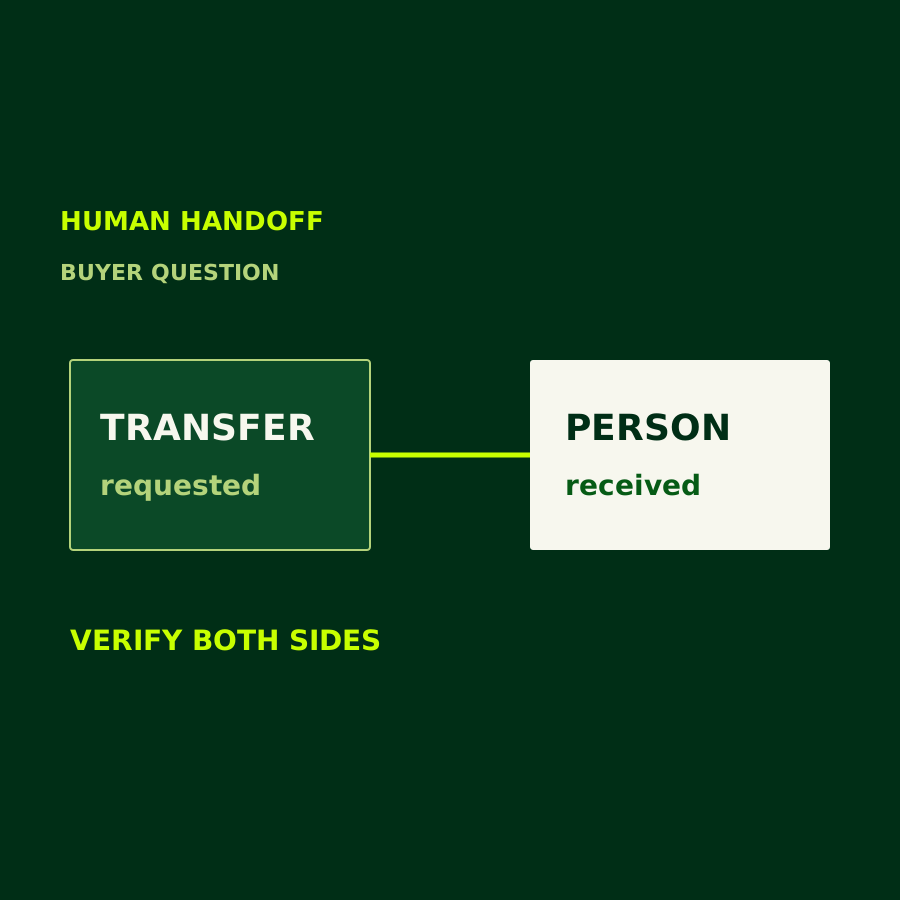
  3. A transfer ends when someone receives it. Transfer requested → Queue rings → Person answers → Context received.

    Escalation

    AI voice agent human handoff best practices

    27 August 2026 / 6 min

12 of 12 studies

Your question. Your starting point.

A desk for
the decision-maker.

Will containment hide unresolved calls?

Start with Trial builder

05Take the research to work

Research you can put to work.

Open a model, change its assumptions and export a working file. These previews use synthetic data. Downloads are free; no email is required.

No email is needed to use or download the tools.

Attachments · 6 working files

True Cost per Completed Call

Investment brief + editable CSV · Economical in the base case

Open and edit

Scenarios on the same denominator

3 rows
ScenarioUnique tasksCompleted tasksMonthly total ($)Steady monthly ($)Cost per completed task ($)Steady cost per task ($)
Low10565873300.742550.745.624.34
Base10566973045.152295.154.373.29
High10568072789.562039.563.462.53

Low: completion −spread, prices and rescue time +spread. High: the reverse, capped so shares never exceed 100%.

Live preview from the completed-task cost using the synthetic example. All test cases remain Not executed; emails stay unsent.

06 / Before you commit

The questions
behind the purchase.

Technology is only part of the decision. Check responsibilities, review the controls and understand which layer you are buying.

01Who owns the failed call?Compare Tool, Build, Expert and Keep.

04Ownership

Choose who owns the failed call.

Pick an ownership model before you shortlist suppliers. The ledger shows what stays visibly with you on each route.

Find my ownership route

Configure an existing service

Bounded workflow, supported integrations, tolerable configuration limits.

Stays with you

  • Testing on your calls
  • Caller policies
  • Fallback staffing
  • Monitoring
  • Contract review

Named in our framework as a responsibility that stays visibly with you on that route. An empty square is not a promise that a supplier carries it.

Tool: configure an existing service

“Instant” means quick access to the tool, not instant production readiness. You still write caller policies, test on your own calls, staff the fallback and review the contract.

02What needs legal and security review?Explore recording, consent and data responsibilities.

06Recording and consent

A working agent is not permission to make the call.

Bring legal and security approvers in before procurement. This lists review responsibilities. It does not assess legality and gives no clearance.

Call direction
ControlWhy it appliesStatusEvidence to request
All-party recording consent (CA)Calls are recordedNeeds evidenceDisclosure script, timing and placement; state-by-state review
Automation disclosureCaller speaks with an AI agentNeeds evidenceScript showing the caller is told they are speaking with an automated assistant
Retention and deletionRecordings and transcripts storedNeeds evidenceRetention schedule (90 days), deletion proof, backup handling
SubprocessorsAudio and text flow to third partiesOpenNamed subprocessors, locations, change-notice terms
Model training on your callsSupplier data-use termsOpenOpt-out confirmation or contract exclusion

In February 2024 the FCC confirmed that AI-generated voices fall within the TCPA’s restrictions on artificial or prerecorded voices (FCC 24-17, February 2024). That does not make every AI call unlawful. HIPAA, PCI DSS and biometric rules need deployment-specific review by qualified people.

Where the data goes in this deployment

Scroll advances one connection at a time.

  1. 01

    Caller

    Voice and phone number. Disclosure happens here, before anything is captured.

  2. 02

    Telephony

    Carrier and region. Audio may be recorded at this layer.

  3. 03

    Agent

    Transcripts and prompts. Subprocessors, retention and training use apply.

  4. 04

    Operational record

    Booking or job system. Least-privilege write access and an audit log.

    Booking or job record

03Which layer are you buying?Explore the supplier directory by deployment responsibility.

09Supplier directory

Know which layer you are buying.

A speech component, a developer platform and a managed service are not interchangeable. Each sits at a different layer of the call and leaves you different work.

Compare by deployment responsibility
  1. Contact-centre suite

    Routing and workforce inside the suite. Verify any handoff from a third-party agent.

  2. Vertical or enterprise specialist

    You keep scope approval, access decisions, acceptance testing and supplier accountability.

  3. Voice-agent platform

    You configure or build: testing, caller policies, fallback staffing and monitoring.

  4. Speech/model infrastructure

    A component. Orchestration, telephony, reliability and releases are yours.

  5. Telephony/network

    Numbers, carriers and routing primitives. Outcomes depend on your configuration.

Layers run from what callers touch (top) to the network underneath. Names are alphabetical within each layer; no supplier paid for inclusion or placement, and none endorses Trace Margin. Implementation partners are not profiled: we do not list named consultancies we have not reviewed.

A more informed first step

Start with
one queue.

Know what has to be true before you automate. The readiness scorecard helps you decide: pilot now, prepare first or hold off.

Check your first workflow Or choose an ownership route ↗Free. Runs locally. Saves to this device only.