
AI voice agent ROI calculator: cost per completed task
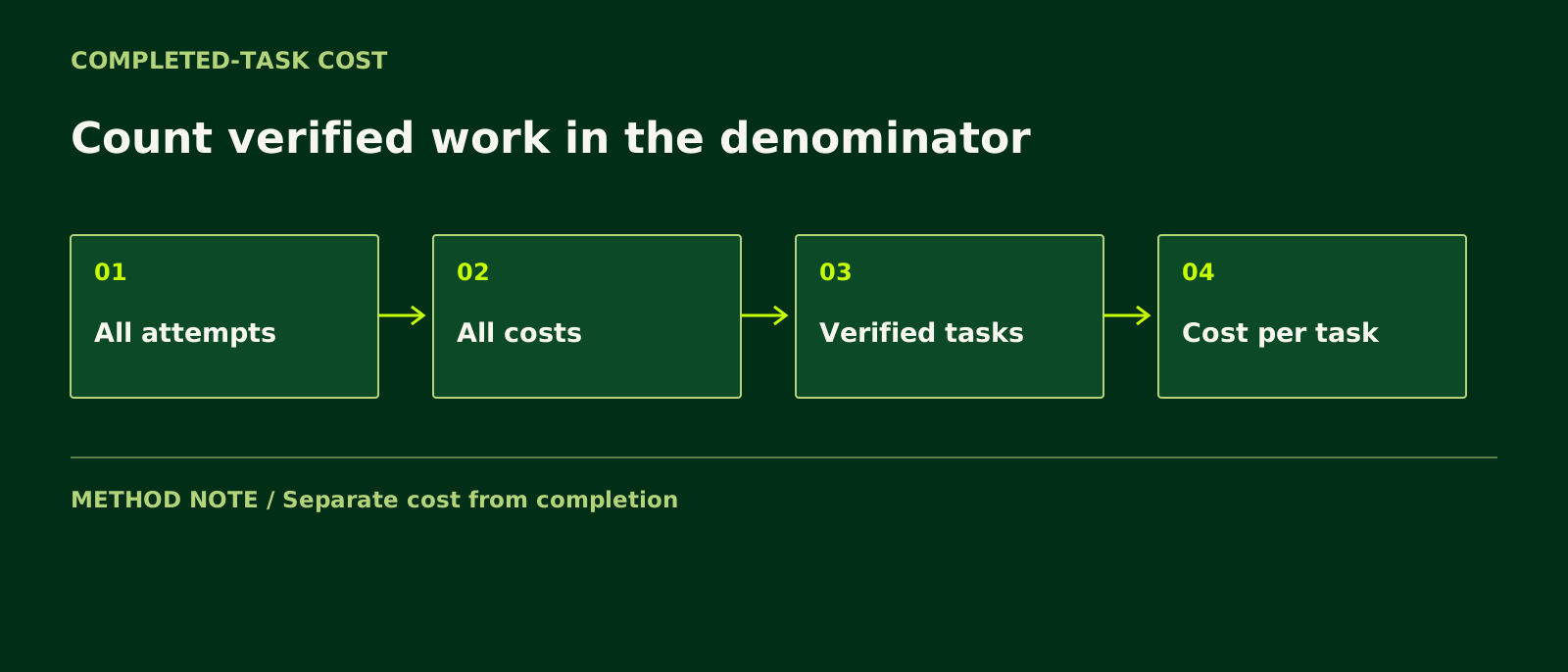
Question. What is the right denominator for an AI voice agent business case?
Divide total cost—every attempt, repeat, rescue, monitoring charge and amortised setup—by unique successful, policy-compliant tasks. Cost per minute and containment rate both flatter the agent.
Containment—the share of calls that never reach a person—is the metric suppliers like best and buyers should trust least. A caller who gives up and hangs up is contained. A caller who is told “you’re booked” when no booking exists is contained. Neither is a completed task.
A worked example
Take a four-minute call at $0.18 per minute. Direct usage is $0.72 per call. If 60% of calls complete the task, direct usage per completed task is $1.20. That figure excludes implementation and human intervention, and it is the smallest number in the business case.
Add telephony, the platform fee, support, a supervisor reviewing calls, the minutes staff spend rescuing failed calls and a year’s amortisation of setup, and the all-in cost per completed task in our synthetic Phoenix plumbing example rises several-fold.
Separate the kinds of benefit
- Cash savings: costs that actually stop, such as an answering-service contract.
- Capacity released: staff hours freed, which only become cash if hours are removed or hiring avoided.
- Speculative contribution: margin from jobs that would otherwise be lost, until measured.
If no task completes, the cost per completed task is not infinite or zero. It is “no successful outcomes”, and the model should say so.