
Best AI receptionist for home services: test the booking, not the demo
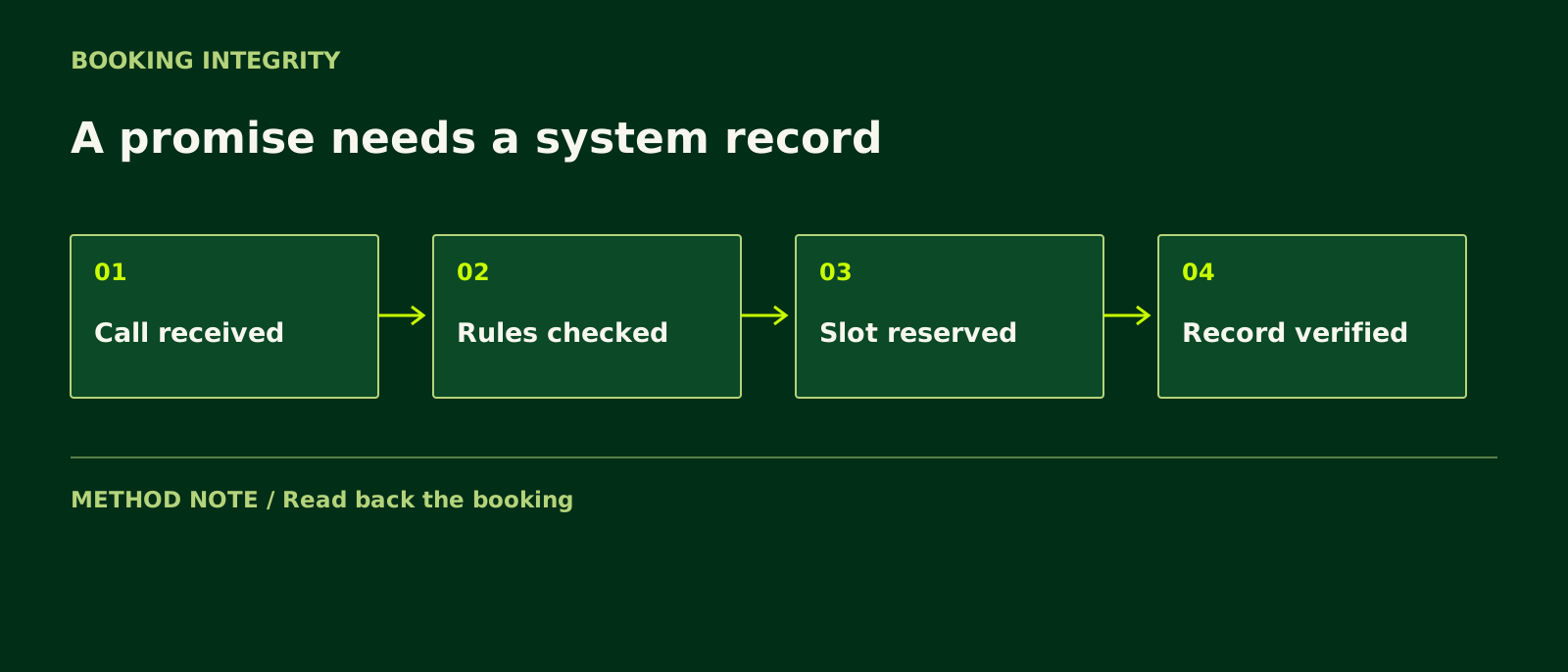
Question. How should a home-services business choose between AI receptionists?
No supplier is “best” in the abstract. The useful comparison is verified bookings per eligible call on your own call mix, with service-area and capacity rules enforced.
Every AI receptionist sounds competent in a demonstration. The caller is cooperative, the slot is free, the address is inside the service area and nobody interrupts. Your phones are not like that. Callers interrupt, change their minds, call from outside the area and ring back twice in ten minutes. The question is not which agent sounds best. It is which one leaves a correct job in your system most often, on calls that look like yours.
Define the outcome before you watch a demo
Write down what “booked” means for you. For most home-services operators it is a job record in the field-service system, with the right job type, address, arrival window and customer, and a confirmation the customer actually received. A call that ends with “you’re all set” but no job record is a failed call that sounded successful.
- Booking requested: the caller agreed to a slot.
- System write confirmed: the job exists and was read back.
- Handoff received: a person answered and knew why the caller was there.
Build a test set from your call mix
Take a month of call dispositions and split them into new bookings, reschedules, information requests and calls that should go to a person. Build synthetic test calls in the same proportions, then add the edge cases that cost you money: out-of-area callers, repeat callers with an open job, unavailable slots and system timeouts. Give every supplier the same set.
Score what the record shows
Score each call against the job system, not the transcript. Count duplicate jobs, wrong arrival windows and bookings beyond crew capacity as failures. Record cost per completed booking for each supplier, including the human time spent rescuing calls.
At 120 test calls per supplier, a completion rate around 75% carries a margin of error of roughly ±8 points. Smaller differences between suppliers are noise.
When the answer is “not yet”
If your current team already books most answered calls and the misses cluster in a lunchtime peak, staffing or routing may fix it more cheaply. If nobody owns the handoff after hours, no agent should run after hours yet. Those are legitimate results of a trial, not failures of one.