
How to stop missing calls for your HVAC business
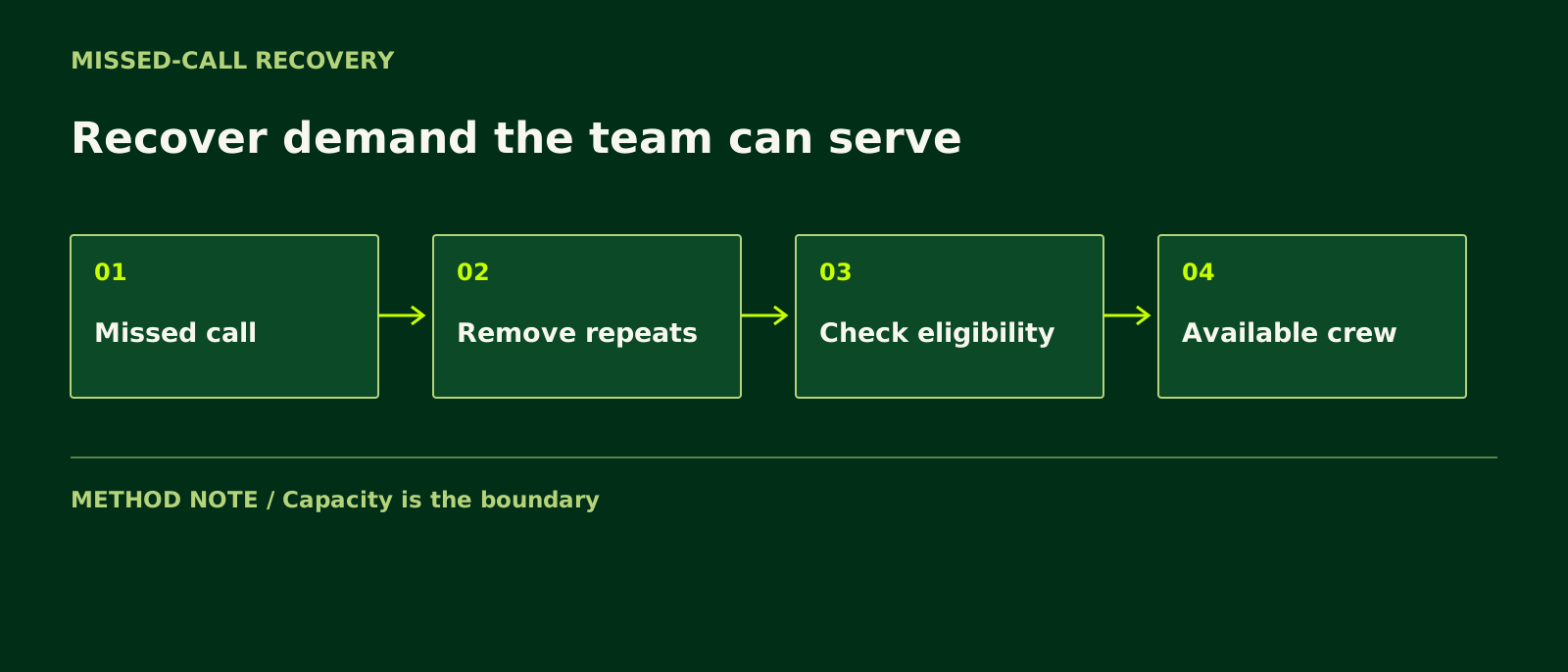
Question. How many missed HVAC calls are genuinely recoverable jobs?
Raw missed-call counts overstate the opportunity. After removing duplicates, ineligible calls and demand you already recover, the remainder is capped by crew capacity—often the binding limit in peak season.
A missed-call report is the most persuasive slide in any AI receptionist pitch, and the least reliable. Four hundred missed calls a month does not mean four hundred lost jobs. Some are the same customer calling three times. Some are suppliers, recruiters and robocalls. Some are existing customers asking when the technician will arrive. And some you already call back.
Work down the waterfall
- Remove duplicates: the same number with the same need inside a short window.
- Remove ineligible calls: spam, vendors, wrong numbers and existing-job queries.
- Remove demand you already recover through callbacks.
- Apply a realistic completion rate for the booking conversation.
- Apply your normal conversion from enquiry to booked job.
- Cap the result at the jobs your crews can actually take.
The last step matters most in HVAC. In a heatwave, recovered calls become bookings you cannot serve—and an unserved booking is worse for the customer than a missed call, because they stopped looking elsewhere.
Where the misses happen decides the fix
If most missed calls arrive while you are open, look first at routing, ring groups, a lunchtime overlap or a callback queue. If most arrive after hours and at weekends, an after-hours overflow pilot is the stronger case, provided someone on call receives the urgent ones.
Contribution from recovered jobs is speculative until measured. Keep it separate from cash savings in any business case.