
How much does an AI voice agent cost?
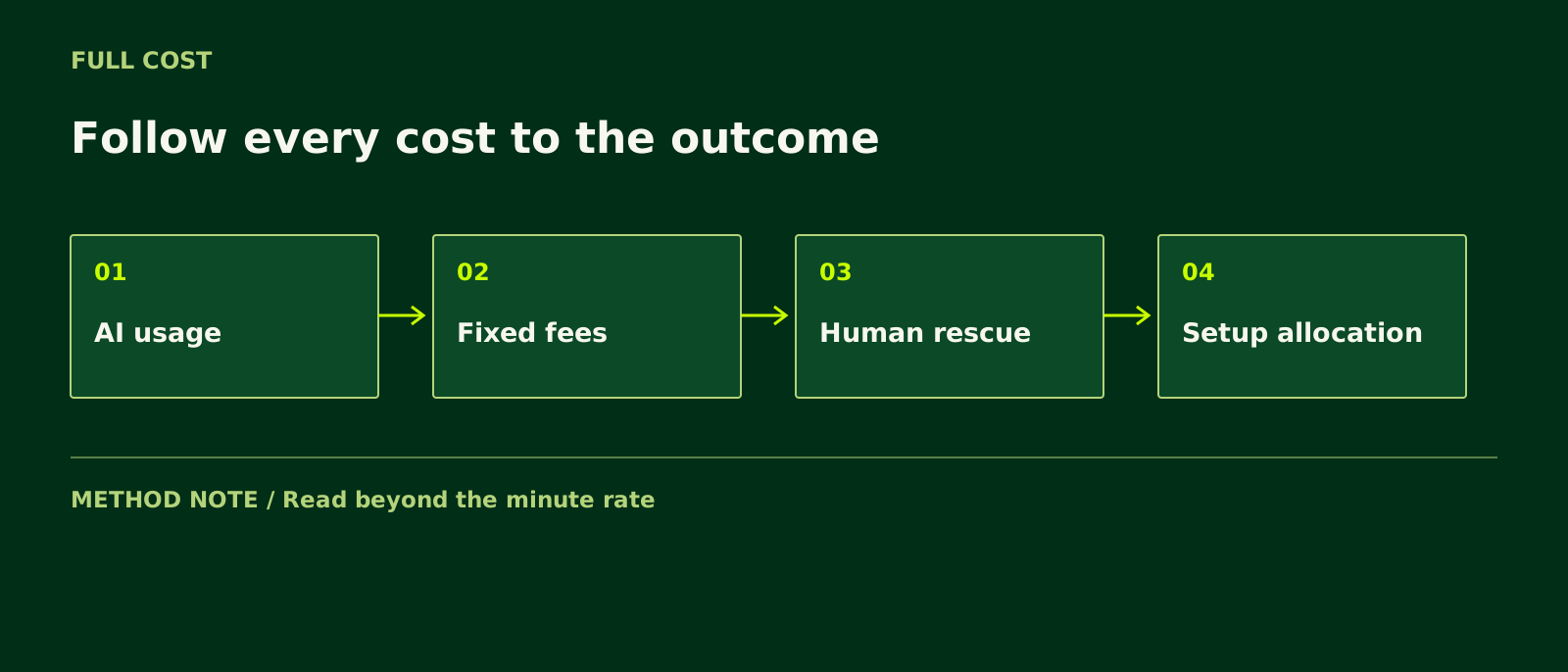
Question. What should a buyer expect to pay, and how do you compare quotes?
For 2026 planning, connected AI minutes are often quoted between roughly $0.08 and $0.35, but the per-minute price rarely decides total cost. Minimums, setup, concurrency, support and rescue labour usually do.
Ask three suppliers for a price and you will get three different shapes: a per-minute rate with a monthly minimum, a platform fee plus a lower rate, and a managed deployment with a large implementation fee and a higher all-in rate. None of them is wrong. None of them is comparable until you apply your workload.
The lines that move the total
- Usage: price per connected minute, and how failed or abandoned calls are billed.
- Minimum commitment: you pay the higher of usage and the minimum.
- Platform and seat fees.
- Concurrency: how many simultaneous calls are included, and what extra lines cost.
- Setup and integration fees.
- Support level: if none is included, your team owns monitoring and incidents.
- Term and exit fees, and what data and numbers you can take with you.
Planning ranges, not benchmarks
For 2026 planning we use $0.08–$0.35 per connected AI minute, $2,000–$15,000 implementation for a constrained small-business scope and $50,000–$250,000 or more for enterprise programmes. These are low-confidence ranges for sizing a budget conversation. They are not what you should pay.
From price to cost per completed task
A cheaper minute that completes fewer tasks can cost more per booking. Once quotes are normalised, divide each supplier’s total by verified completions from a trial on your own calls.
Leave unknown terms unpriced rather than guessing. A total with a missing line is a lower bound, and should be labelled as one.