
AI receptionist vs human receptionist vs answering service
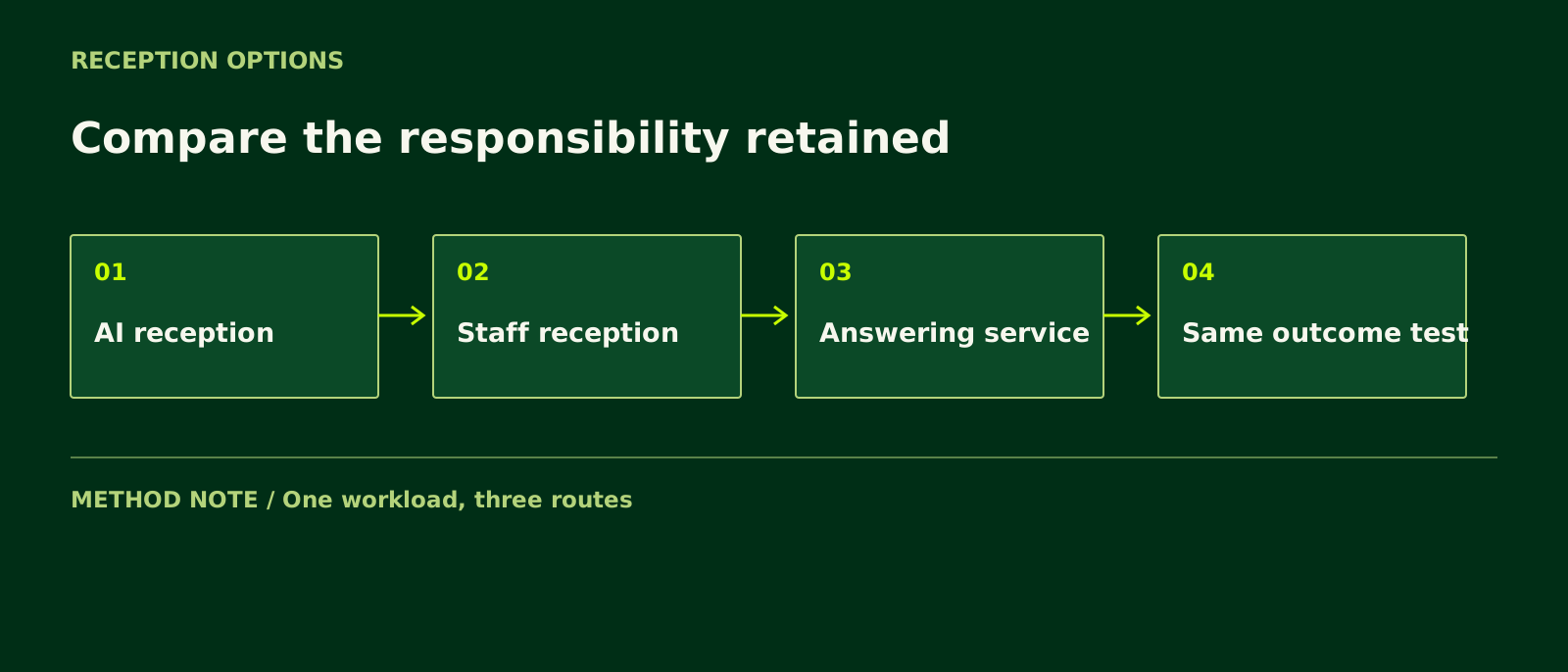
Question. When is an AI receptionist cheaper than staff or an answering service?
Each option wins under different conditions. AI tends to win on after-hours coverage of routine tasks; staff win on judgement and complex calls; answering services win when the task is a message and a promise.
The comparison is usually framed as AI against people. The realistic comparison is three ways, on the same denominator: what does each completed task cost, during which hours, and who is accountable when it goes wrong?
Where each option is strong
- In-house staff: judgement, exceptions, upset callers and anything that needs authority.
- Answering service: coverage at a predictable monthly cost when the task is taking a message.
- AI agent: routine, rules-based tasks that write to a system, at any hour, with a person behind it.
Coverage changes the arithmetic
An answering service that takes a message at 21:00 has not booked the job; your team still has to call back. If half those callbacks fail, the answering service’s cost per completed task doubles. An agent that books directly can win here—if it writes the job correctly and hands urgent calls to someone on call.
Accountability
With staff and answering services, someone is accountable for every call. With an agent, accountability has to be designed: a named owner for handoffs, monitoring and incidents. Without that, the cheapest option on paper is the most expensive one in practice.