
How to test dental scheduling across Dentrix and Open Dental workflows
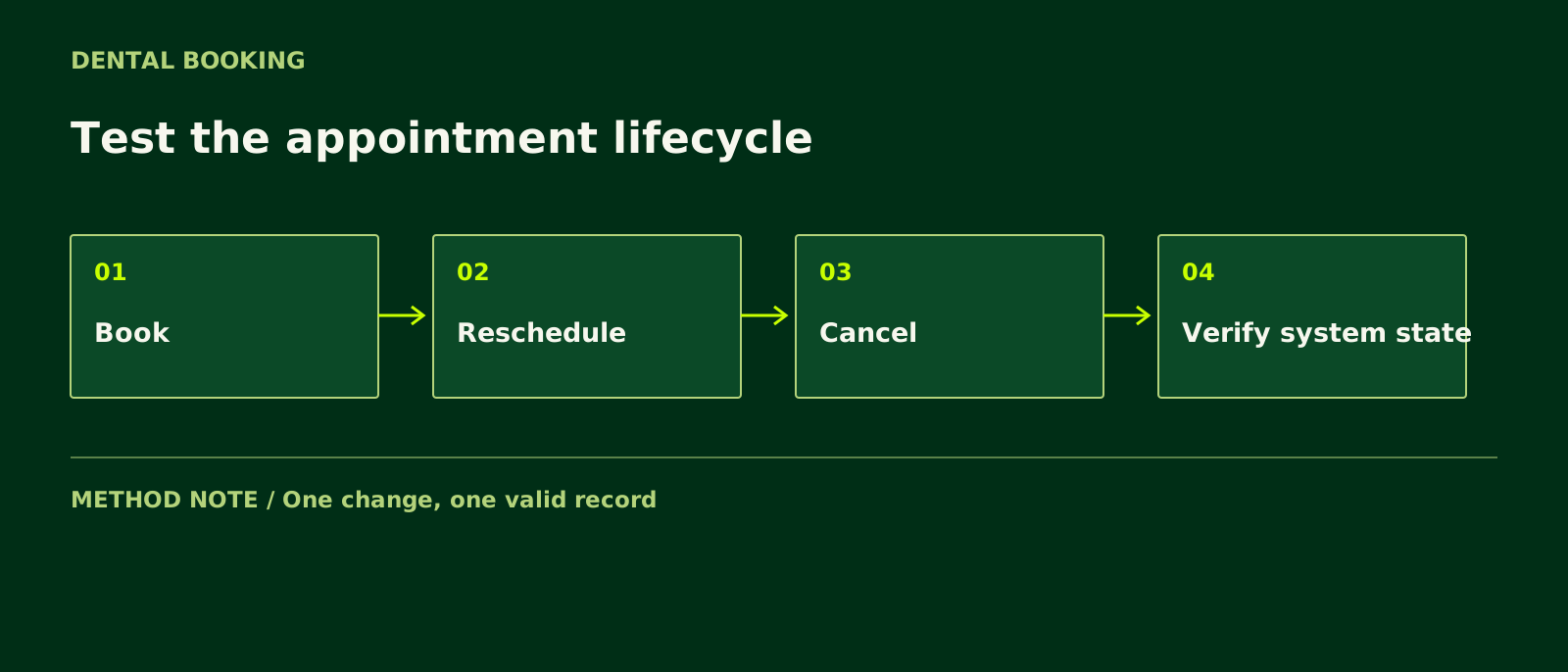
Question. How do you know an agent leaves the practice-management system in the right state?
Test the resulting system state, not the conversation. Each case needs an expected state, a prohibited action and evidence. Integration support for any specific system must be verified separately.
Dental scheduling looks simple until you write the rules down: appointment types with fixed durations, clinicians who can only do certain procedures, locations without a paediatric hygienist, a new-patient intake rule, a cancellation window and an insurance boundary the front desk knows by instinct.
Test the state, not the script
For each test case, write what the practice-management system should show afterwards and one thing it must never show. “One hygiene recall, 60 minutes, at the patient’s usual location” is testable. “The agent handled it well” is not.
- Duplicate writes after a timeout and retry.
- Two patients with the same name.
- Reschedules that leave both the old and new appointment booked.
- Bookings shorter than the appointment type requires.
- Pain or swelling routed to staff, never advised on.
Integrations are a separate question
Whether a supplier writes to Dentrix, Open Dental or another system—and through which route—must be documented by that supplier and verified in a test environment. Our test pack checks outcomes whatever the integration path.
Passing synthetic tests is not certification, HIPAA compliance or clinical approval.